
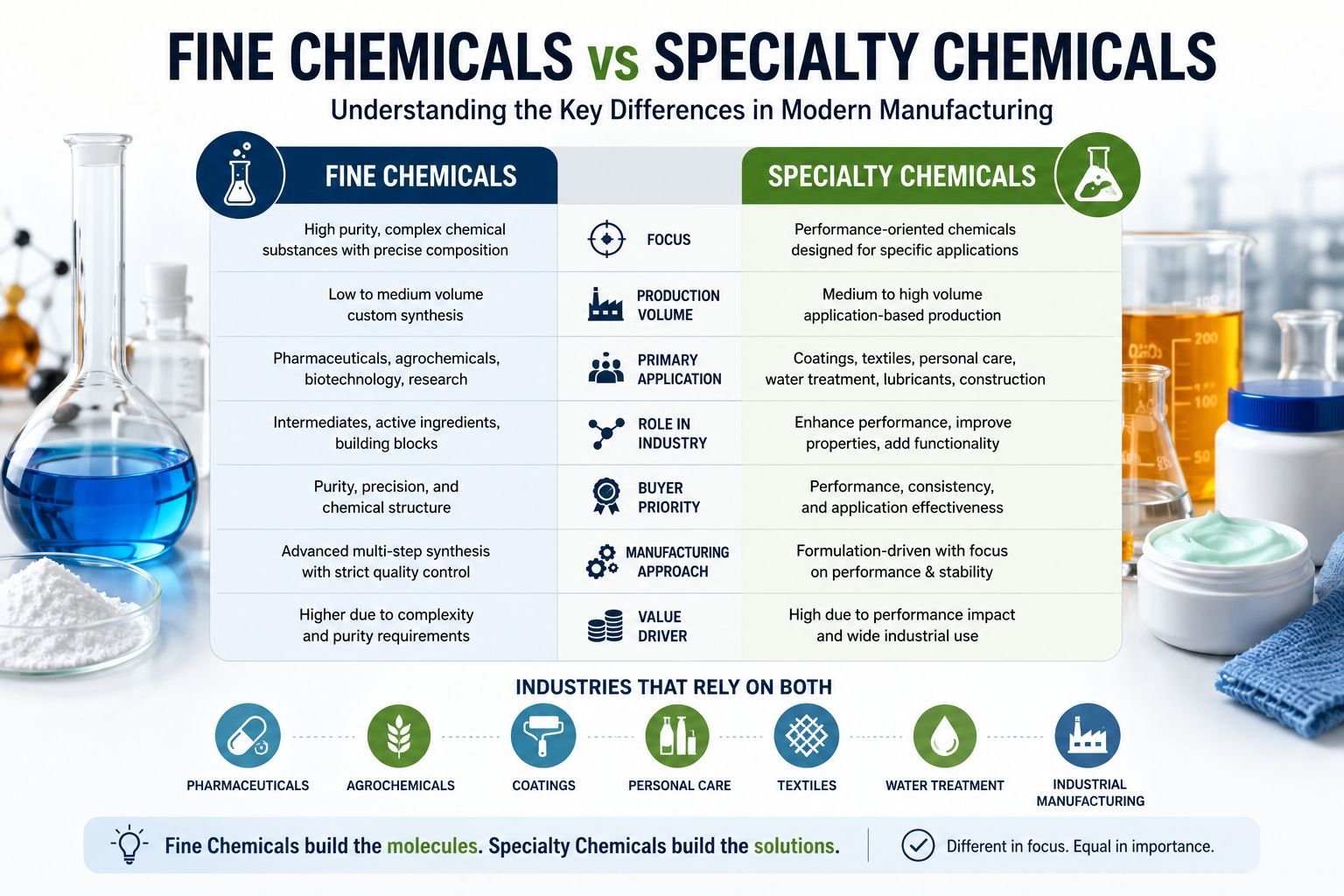
Fine Chemicals vs Specialty Chemicals
What Is the Difference Between Fine Chemicals and Specialty Chemicals?
Fine Chemicals vs Specialty Chemicals: Understanding the Key Differences
The chemical manufacturing industry includes several product categories, but two terms often create confusion among buyers, manufacturers, and industrial professionals: fine chemicals and specialty chemicals.
Although these categories are closely related, they serve different industrial purposes and follow different manufacturing, application, and market approaches.
Understanding the difference between fine chemicals and specialty chemicals is important for procurement teams, exporters, manufacturers, and industrial buyers looking to select the right products for their applications.
What Are Fine Chemicals?
Fine chemicals are pure, complex chemical substances manufactured in limited quantities using advanced multi-step chemical processes.
These chemicals are generally produced for:
- Pharmaceuticals
- Agrochemicals
- Biotechnology
- Research applications
- High-value industrial synthesis
Fine chemicals are usually manufactured according to precise customer specifications and strict purity standards.
They often act as:
- Intermediates
- Active ingredients
- Building blocks for larger formulations
Purity and process control are extremely important in fine chemical manufacturing.
What Are Specialty Chemicals?
Specialty chemicals are performance-focused chemical products designed for specific industrial functions or end-use applications.
Unlike fine chemicals, specialty chemicals are valued primarily for what they do rather than their chemical composition alone.
These chemicals are widely used in:
- Paints and coatings
- Personal care products
- Textile processing
- Water treatment
- Construction chemicals
- Lubricants
- Industrial manufacturing
Specialty chemicals are application-oriented and often customized for performance enhancement.
Fine Chemicals vs Specialty Chemicals: Key Differences
The Core Difference: Purity vs Performance
The simplest way to understand the difference is:
Fine Chemicals = Purity-Focused
They are manufactured with extremely precise chemical structures and high purity levels.
Specialty Chemicals = Performance-Focused
They are developed to achieve specific industrial or functional outcomes.
Both categories are high-value, but their industrial purpose differs significantly.
Why Fine Chemicals Are Important
Fine chemicals play a critical role in industries where molecular precision is essential.
For example:
- Pharmaceutical APIs require high-purity intermediates
- Agrochemical production depends on precise synthesis compounds
- Biotechnology applications need tightly controlled chemical structures
Even a small impurity can affect product quality, safety, or effectiveness.
This is why fine chemical manufacturing requires:
- Advanced process control
- Strict quality assurance
- Technical expertise
- Controlled production environments
Why Specialty Chemicals Are Important
Specialty chemicals help improve product functionality, manufacturing efficiency, and industrial performance.
For example:
- Coating chemicals improve durability
- Water treatment chemicals improve purification efficiency
- Textile chemicals improve finishing quality
- Personal care ingredients improve formulation stability
Specialty chemicals are becoming increasingly important as industries demand better performance and customization.
How Global Demand Is Changing
The global market is seeing strong growth in both fine chemicals and specialty chemicals due to:
- Expanding pharmaceutical manufacturing
- Advanced industrial applications
- Higher quality expectations
- Regulatory compliance requirements
- Customized manufacturing demand
However, specialty chemicals are currently growing faster because industries increasingly prioritize performance-based manufacturing solutions.
India’s Growing Role in Fine and Specialty Chemicals
India has emerged as a major global manufacturing hub for both fine chemicals and specialty chemicals.
Indian manufacturers are increasingly recognized for:
- Technical expertise
- Export capabilities
- Quality manufacturing
- Cost competitiveness
- Regulatory compliance
- Strong industrial infrastructure
As global buyers diversify sourcing strategies, Indian chemical manufacturers continue gaining international trust across multiple industries.
Which Is More Profitable: Fine Chemicals or Specialty Chemicals?
Both sectors can be highly profitable, but profitability depends on:
- Technical complexity
- Market demand
- Customization
- Compliance requirements
- Production scale
Generally:
- Fine chemicals offer higher margins due to complexity and purity requirements
- Specialty chemicals offer strong scalability due to broad industrial demand
Many modern chemical companies operate in both segments to diversify growth opportunities.
Future Trends in the Chemical Industry
The future of the chemical industry is increasingly driven by:
- Precision manufacturing
- Sustainable chemistry
- Customized solutions
- Regulatory compliance
- High-performance industrial applications
Both fine chemicals and specialty chemicals will continue playing major roles in global manufacturing growth.
Companies that invest in quality, innovation, and technical expertise are expected to remain highly competitive in the coming years.
Conclusion
Fine chemicals and specialty chemicals are both essential parts of the modern chemical industry, but they serve different purposes.
Fine chemicals focus on purity, precision, and complex synthesis, while specialty chemicals focus on industrial performance and application functionality.
Understanding these differences helps global buyers, manufacturers, and procurement teams make better sourcing and production decisions.
As industrial demand continues evolving, both sectors are expected to see strong global growth driven by innovation, quality, and advanced manufacturing needs.
FAQs:
What is the difference between fine chemicals and specialty chemicals?
Fine chemicals focus on purity and precise chemical composition, while specialty chemicals focus on functional industrial performance.
What are fine chemicals used for?
Fine chemicals are commonly used in pharmaceuticals, agrochemicals, biotechnology, and research applications.
What are specialty chemicals used for?
Specialty chemicals are used in coatings, textiles, cosmetics, water treatment, lubricants, and industrial manufacturing.
Are fine chemicals and specialty chemicals the same?
No. Fine chemicals are purity-focused compounds, while specialty chemicals are application-focused performance products.
Why is India growing in fine and specialty chemical manufacturing?
India offers strong technical expertise, manufacturing infrastructure, export capabilities, and competitive production advantages.
Read More Articles Below: